



It happens every semester.
A student stops by my office hours near the end of the term. No real agenda. No urgent question. Usually, they hover in the doorway for a second, like they’re not sure this is worth saying.
Then the line comes.
“I’m probably never going to start a company.”
Pause.
“But this class changed how I think.”
I’ve heard that line, or something close to it, every semester I’ve taught at USC. Which is strange, because I was hired to teach entrepreneurship. Customer discovery. Business models. Lean startup. Pitch decks. All the usual suspects.
But every semester, students who clearly weren’t going to become founders kept telling me the class had done something to them that they couldn’t quite name.
For a while, I figured they were being polite. Students are good at that. Especially good students. They know how to end a class with a graceful thank you and a half-sincere “I learned so much.” But these comments felt different. They were too specific. Too relieved. Too personal. So I started paying attention.
What they were telling me was not that they had learned how to start a company. They had learned how to operate without being told what to do next. How to make a decision before all the information was available. How to take responsibility for something before they knew if it was going to work.
How to move without permission.
I thought I was teaching startups. Turns out they were learning a posture.
Once I saw it in them, I started seeing it everywhere. Not just in founders. In operators, parents, coaches, department heads, board chairs, and first-year managers. The teammate who finally picks up the project that everyone has been politely dodging. The parent who keeps having the hard conversation after everyone else is exhausted by it. The leader who stops waiting for perfect alignment and says, “Okay, here’s what we’re going to do.”
What they had in common wasn’t expertise. It wasn’t certainty. It wasn’t even confidence. It was that when things were not clear, they moved forward anyway. Not because they had better information than everyone else, but because they decided to take responsibility for what happened next.
They were not always right. But they were unmistakably in it.
That matters more now than it used to, because drifting has become incredibly comfortable. The defaults are smarter. The tools are better. The recommendations are more accurate. The drafts are cleaner. The routes are optimized. The summaries are useful. The options are endless. You can have a very productive week now without ever quite deciding what you are producing toward.
I know because I struggle with it myself. Not occasionally. Daily. I can research instead of choosing, polish instead of publishing, and generate a plan instead of owning a direction. On my better days, I call it being thoughtful. On my more honest days, I know I’m circling.
AI did not create this problem, but it removes a lot of the friction that used to expose it. Before, if you were avoiding a hard decision, the avoidance had a smell. You could feel the procrastination. You could see the mess on your desk. You knew, at some level, that you were circling.
Now the circling looks like work. It has bullets. It has options. It has a surprisingly good executive summary.
Which is why I needed a name for the thing that pulls me back. So I started calling it FounderCore.
FOUNDER, not because everyone should start a company.
The world does not need everyone launching an app, raising a seed round, and describing themselves as “building at the intersection of” anything. Founder because founders do not have the luxury of outsourcing direction. If they don’t know where they are going, nobody is going to figure it out for them.
CORE, not visible six-pack abs.
Core, as in the internal stabilizers. The muscles that keep you upright when everything around you is shifting. The ones you don’t really notice until they’re weak.
That’s what I kept seeing in my best students. Not a founder’s ambition. FounderCore. The internal capacity to stay in charge of your own direction and focus on what matters most.
I didn’t invent the posture. I simply named it so I could recognize it when I saw it. In them. In other people. In myself.
There are four of these muscles. They are trainable. They atrophy if you don’t use them. And in an AI world, you can go a long time without using them and not notice.
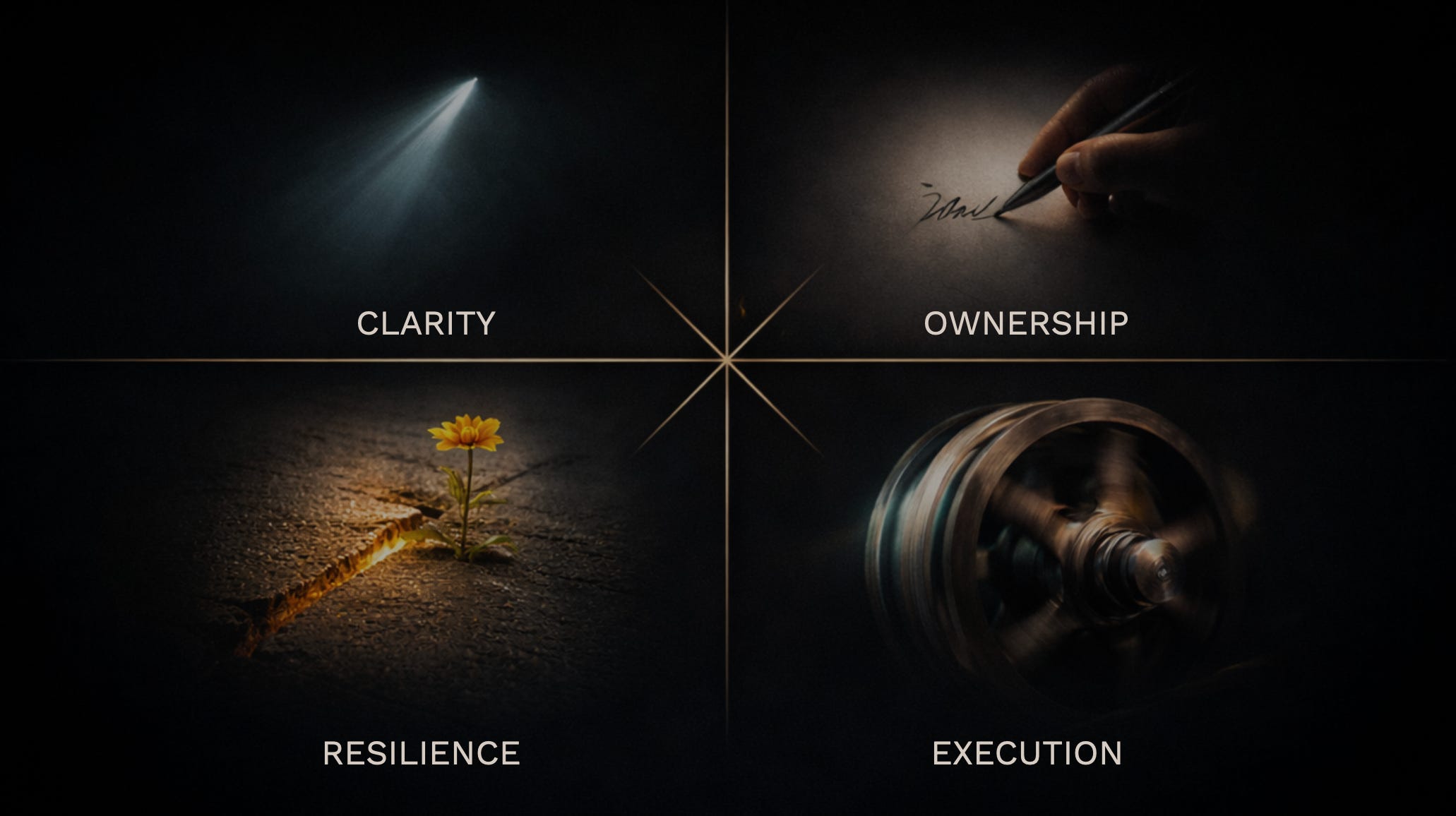
Clarity is the first one. The one I trust most. Which makes it frustrating that I still find ways to delay acting on it.
AI is annoyingly good at making the focus problem disappear. It doesn’t force you to choose. It hands you fifty good options. None of them obviously stupid. Which is part of the problem.
It sounds helpful until you notice you have stopped choosing what matters most and started choosing what you can’t bring yourself to say no to.
Clarity is about choosing fewer things and meaning it. Picking the few that count, letting the rest go. Sounds simple. It isn’t.
The discipline is disappointing most of your options. That’s the muscle.
Ownership is the one I’ve gotten wrong most often. I keep confusing it for being in charge. Same neighborhood, different muscle.
A title puts you in charge. Ownership is something else. It’s being close enough to the consequences that you actually feel them. You can be in charge of a thing and totally insulated from what happens to it. That’s not ownership. That’s an org chart.
AI can surface options, find pathways, generate plans, draft messages, build spreadsheets, and simulate conversations. What it cannot do is sit across from someone and look them in the eye. It cannot carry the awkward silence after a hard decision. It cannot feel the weight of the outcome.
That part doesn’t transfer. Not to a tool, not to a delegate, not to a process. It stays where it is.
Execution is where it all stops being theoretical.
It’s what happens when you stop refining and ship. When you publish. When you hit send. When you make the call. When the idea leaves the private world where it still works perfectly and enters the much harsher world of other people.
I know this one too well. I can turn “almost ready” into an entire operating system.
AI is seductive here because it lets you simulate execution endlessly. You can outline, rewrite, tighten, expand, compare, reframe, and polish until the idea has no fingerprints left on it. The trouble is that judgment doesn’t grow there. It grows when the thing is out and you have to live with what happens.
Execution is where you find out whether your thinking survives contact with reality.
Resilience is the last one, and the least photogenic.
I keep wanting it to be more inspiring than it actually is. Most of what gets called resilience online is grit dressed up as personal branding. The real version is duller. It’s staying in the game after the game stops being fun.
When the feedback is brutal. When the thing you were so excited about now looks embarrassingly obvious, naïve, or poorly timed. When the room goes quiet. When quitting would be the rational move. That’s where most people drop out.
The work is making the next call. Even when it hurts. Especially then.
Clarity. Ownership. Execution. Resilience. That’s FounderCore.
A set of muscles for staying in charge when the world keeps offering to make things easier than they should be. Muscles you can train or let atrophy.
I’ll come back to each one in the issues ahead. Today is just the map.
One thing to carry. FounderCore lives between two failure modes. One is “I’ll do everything myself,” which is ego with better marketing. The other is “Let’s see what ChatGPT says,” which is drift with a research assistant. The work is to sit between them and not get pulled toward either.
I’m. In. Charge.
Not of every task. Not of every outcome. Of the direction.
Use AI aggressively. Delegate constantly. Hand off whatever can be handed off. Let the tools make you faster, smarter, more capable, less buried in nonsense. But do not hand over the steering wheel and call it efficiency.
The direction stays with you.
That’s the whole point.
I love this. Thanks Rob!