


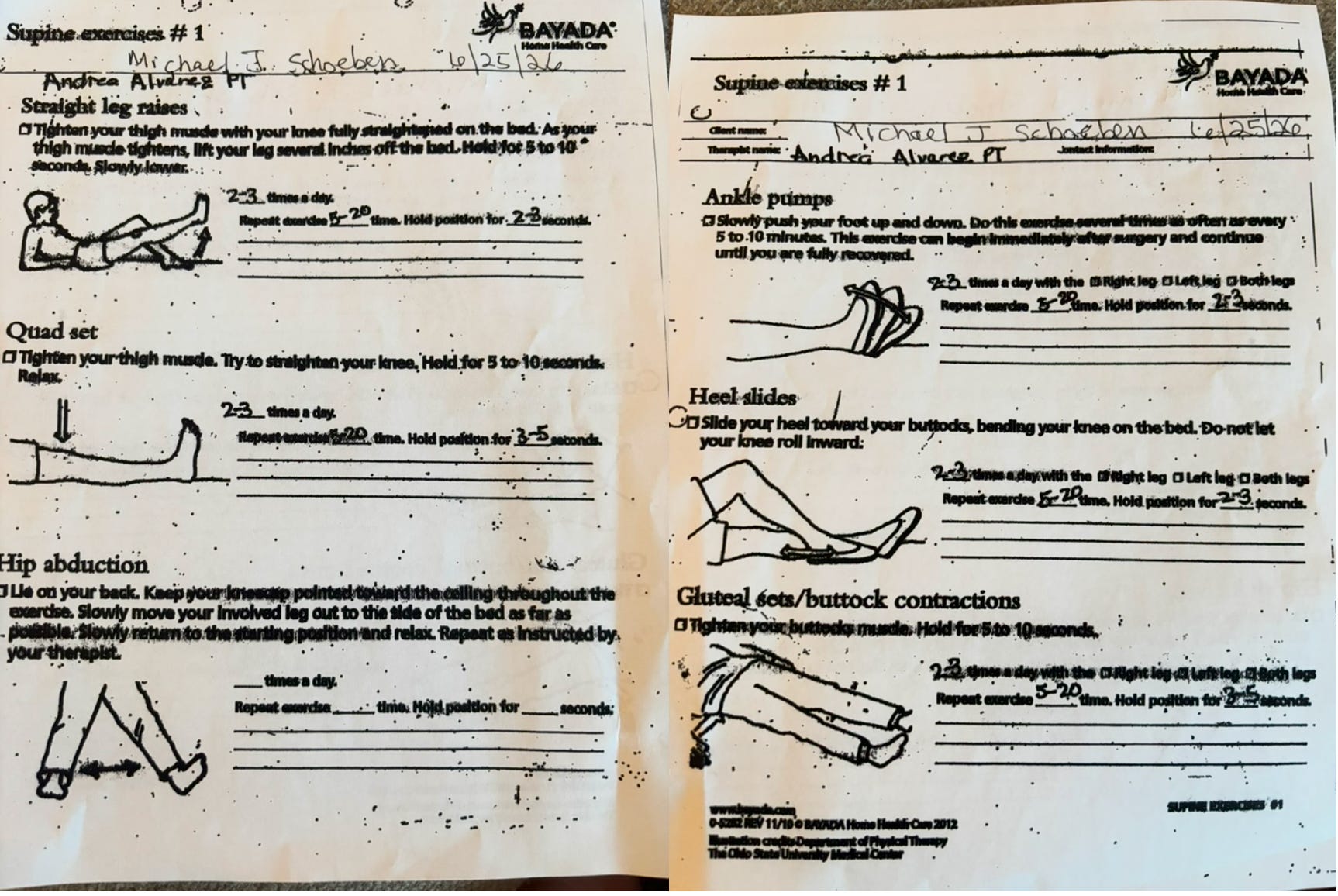
The photos arrived the way pictures of paper always do, shot at an angle with half the page lost to shadow. Six exercises scribbled on a home health worksheet, the reps filled in by hand in the margins. Barely legible. Ankle pumps and heel slides. The small, unglamorous work of getting an old body to move again.
My father is eighty-six. He’s been in and out of the hospital over the past six months. And now he is supposed to do these exercises two or three times a day, while everyone in the family takes turns reminding him.
She didn’t have to tell me what she wanted. I’ve been getting this same request, in one shape or another, for most of my adult life.
Make it pretty.
It usually comes from Liz, attached to one of her projects, the kind that matters enough that ordinary good won’t clear the bar. She hands it over and asks some version of the question, and I take the mess and make it clearer and sharper, more worthy of whatever job it’s trying to do.
I have always liked being asked. I may perform a little irritation in the moment, but we all know it’s an act.
Over the last few years, this has become one of my jobs. Not an official job. Just the one people seem to know I’ll do.
And lately, I have a new tool for it.
I’m supposed to be careful about saying that part out loud. I write all the time about what we hand away when we let machines do too much of our thinking, and I believe every word of it. But it would be dishonest to leave out the other thing that’s happened, which is that being good at this has become a small new piece of who I am.
I’m not an AI guru. There are people building far stranger and more impressive things than I am. But in my own little circle, I’m better than most, and I’ve become the person who gets called. I know how to talk to the machine. I know when to push it and when to throw out its first answer, rather than trusting it just because it arrived fast.
The tool matters. But the real power is in how you use it.
So I opened my father’s exercises during those quiet moments before bed and worked with Claude to clean them up.
First, I pulled the six exercises out of the shadows and turned the worksheet into a clean PDF anyone could follow. A few years ago, that would have been the whole story. Prettier was all the request had ever asked for, and all I could have given it.
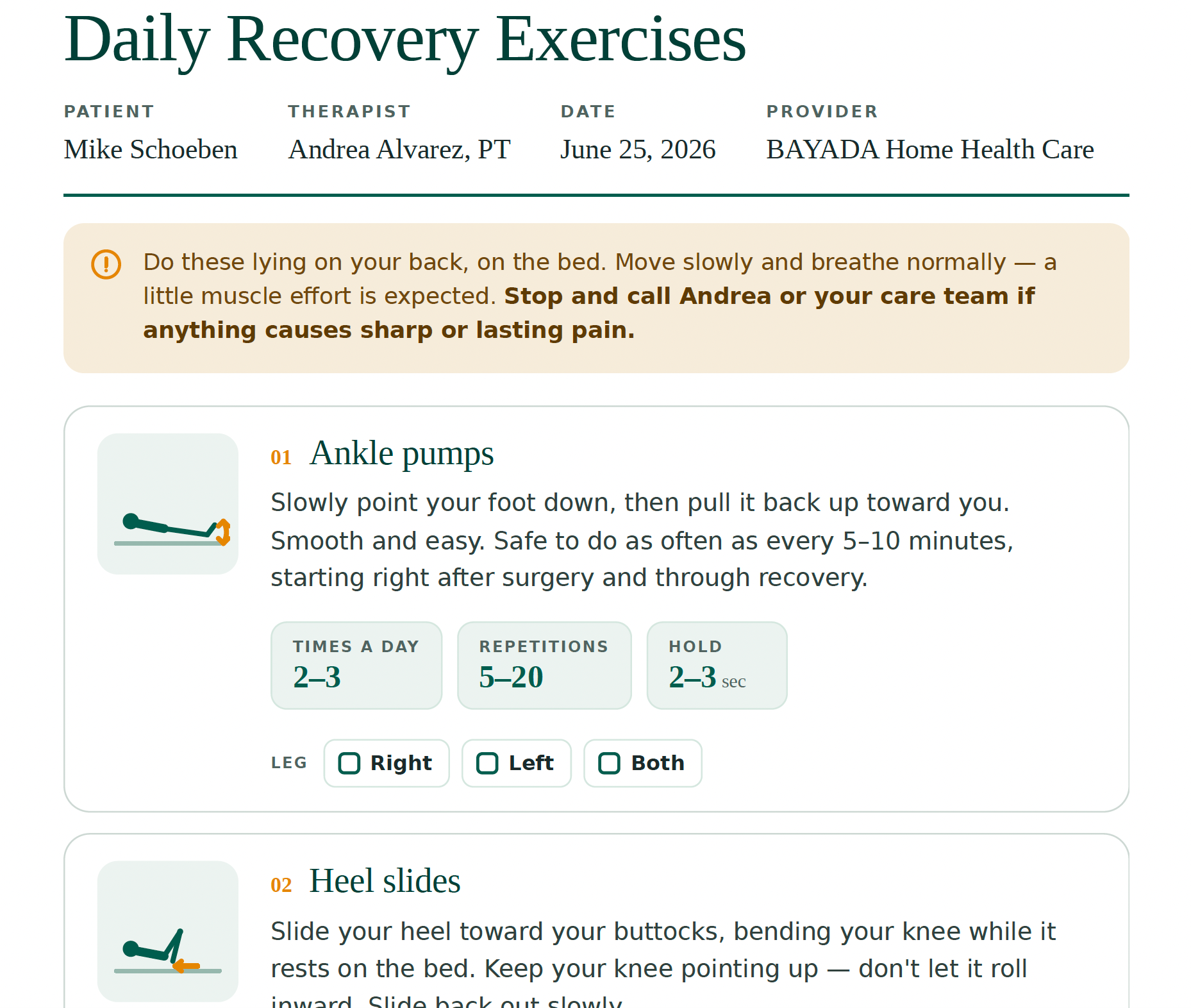
But this time, the PDF was just the warm-up.
By the end of the next day, I had turned those two pages into a small hosted app and put it on my father’s phone. Nothing anyone would call a product. A fitness tracker built for exactly one person. It teaches him the six exercises, lets him log a session when he finishes each one, and nudges him toward the next.
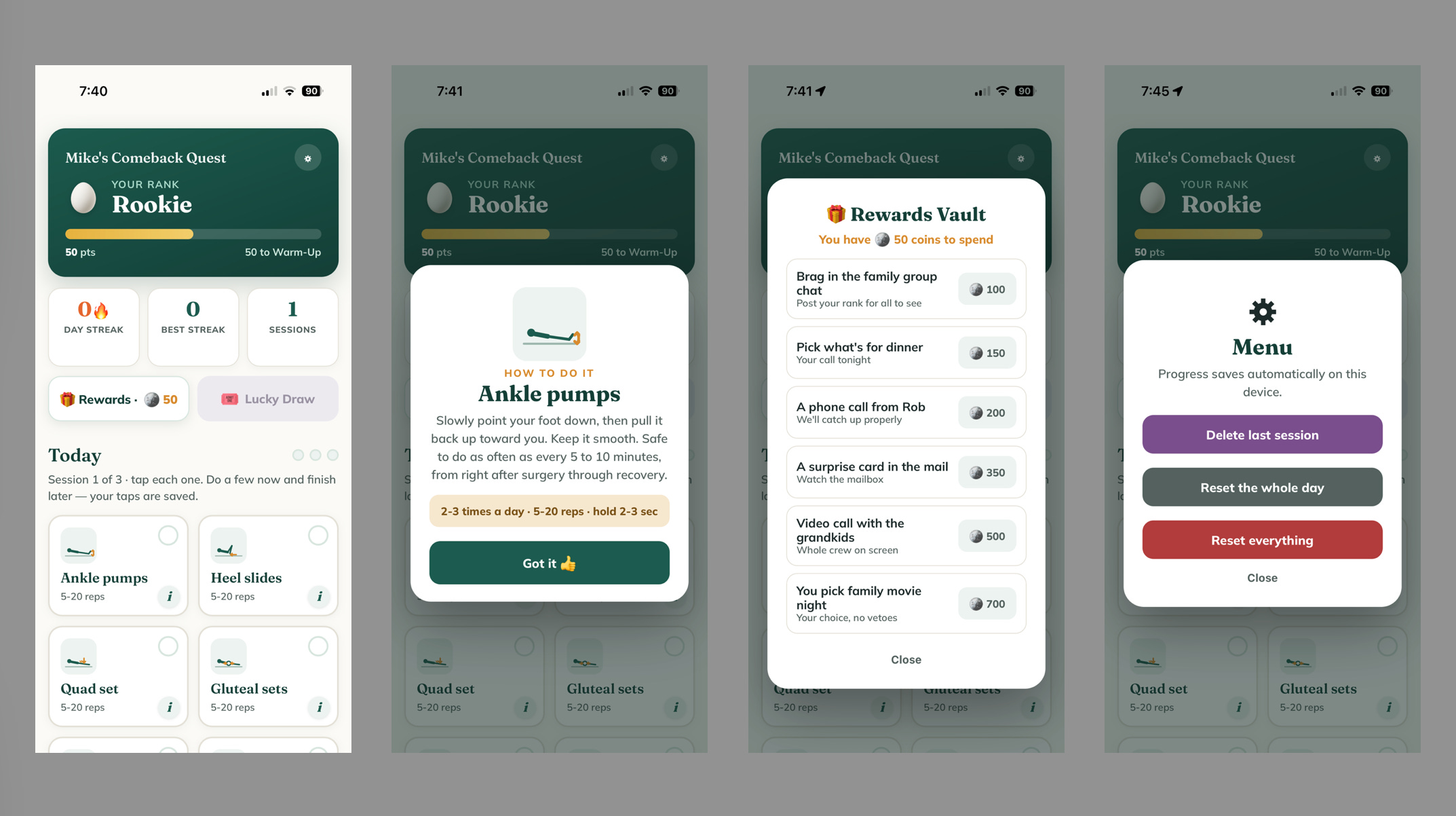
We'd always nagged him about physical therapy. Now we could show it to him instead.
My sister added it to his iPhone home screen at the house and handed him the phone. I was in Manhattan Beach, on speaker, listening while he met this little machine I’d built for him.
My father is a retired mechanical engineer, which means he trusts a machine only after he understands how it works. A carburetor will show you its logic if you take it apart. So will a furnace, or a transmission, or anything with screws and a panel.
He has never been especially at home with digital things, but that didn’t change the way he approached this one. To him, a machine is a machine. You figure it out by pressing on it until it gives up its logic.
So that’s what he did.
He wanted to know what counted as a session and what would happen if he tapped the wrong thing. He entered data just to see where it went, handed the phone back to my sister, took it again, and pressed a few more buttons until the app started to make sense to him.
Then he found the part of the app that clears your logged data, and that was the part he wanted to understand.
If there were three sessions in a day, could he reset just one of them, or would the whole day get wiped?
At first, I thought he was testing the app. Then I understood he was testing whether it would forgive him.
Could he miss a session, get something wrong, or start one exercise over without losing the rest?
My father has a habit of calling himself a burden before anyone else can. He does it lightly, almost as a joke, but not all the way. He told me I’d regret this. He’d have too many questions, and I’d get tired of answering them.
I told him I liked helping.
Then I gave him the rest of it, a line that came up from somewhere older than either of us was thinking about.
Special orders don’t upset us. All we ask is that you let us have it your way.
He laughed, because of course he knew it.
What he wasn’t thinking about was that I worked there. The Burger King off Highway 83 in Delafield, Wisconsin, my first real job at sixteen, minimum wage. Long before making it pretty became my role in this family, flame-broiled burgers dressed your way earned me a paycheck.
Forty years later, that ancient Burger King tagline is how I tell my father he can ask me for what he needs, as often as he needs it.
I don’t resent any of this.
I’m wary of what these tools take from us, the way they can flatten judgment and quietly leave us less capable while we feel more productive. All of that is real.
But this week the machine gave something back. Nothing you’d put on a conference slide. It gave me back just enough of an old skill to be useful to one old man in Green Valley trying to get back on his feet.
That was enough.
My little app may not work for him. It may sit untouched on his phone, a screen away from the sweepstakes entries. His track record gives me no real reason to believe he’ll use it. I’m hopeful, not Pollyanna.
But for one phone call the story changed.
And when he went looking for the reset button, I understood what he was asking.
Can I start over?
Yes.
As many times as you need.