


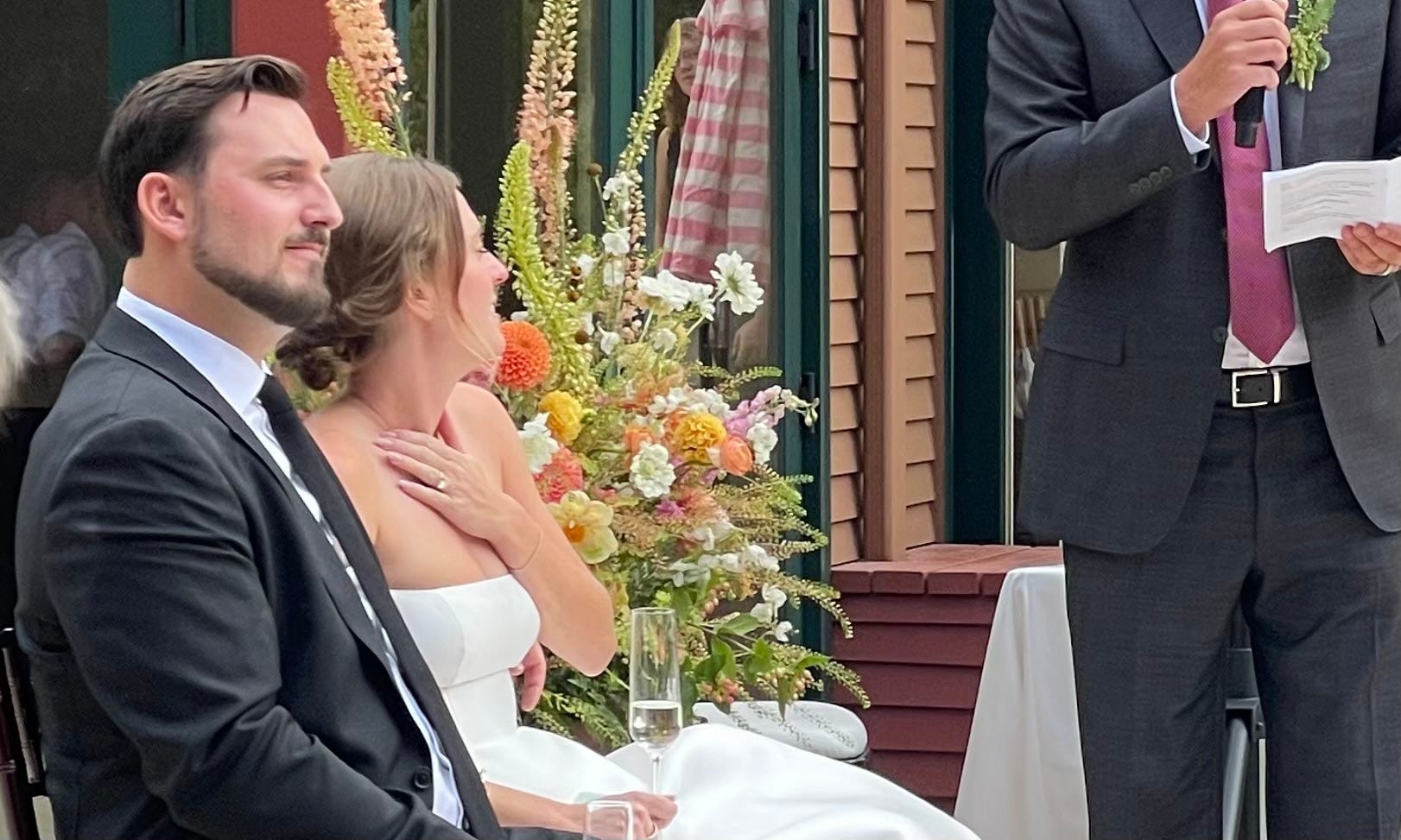
Julia’s sister, Laura, was two minutes into her toast when Liz knocked a full glass of champagne into my lap. I spent the rest of it rubbing the wet end of my tie between my hands, trying to generate enough heat to dry it. Soon I would be standing in front of 120 people with a microphone in my hand, dry tie or not.
I heard most of Laura’s toast anyway. She talked about Riley showing up, about him noticing what needed doing and handling it without mentioning that he had.
Nobody, all night, had brought up sports.
Under the napkin in my lap were the pages I had been working on for weeks. They opened with a story about a round of golf.
Six years ago, I played a round with my youngest son at Westchester, a nearby public course not exactly known for its pace of play or the quality of its fairways. Neither of us played particularly well, which was fine, because for me it was never really about the golf.
It was reconnaissance.
Riley was in college at LMU, fifteen minutes away, close enough that I could pretend he was still nearby and far enough that his life had become mostly his own. I had four holes of small talk in me and one real question.
On the fourth or fifth tee, I finally asked it.
“Ri, I know things have been hectic. Do you have any interest in dating?”
“Oh, I have a girlfriend.”
He said it the way someone might mention a dentist appointment on Tuesday.
“Really? What’s her name?”
“Julia.”
“Cool. Cool, cool, cool.”
Then we both bogeyed the hole.
I had gone fishing on a golf course and discovered that my son had quietly started building the rest of his life. I have been telling that story ever since, and it worked Saturday night again. The room laughed in all the right places. Sitting there with the pages in my lap, I finally listened to it. Four holes of me working up to a question, and me not knowing the answer.
Riley is in it for six words.
Riley has always resisted simple characterization. Growing up, people put him in the obvious box. Gifted athlete. Shortstop, wide receiver, the kid with the hands.
All of it was true. I let it stand in for the whole person, and I should be honest about why.
I spent years in the stands. Most of the close friendships I still have as an adult came out of those seasons, made with other parents while our sons did something we could watch. It was the best social life I have ever had, and my son was the occasion for it. When people asked about him, I reached for the box, because the box was where I lived too.
Then the games ended. I kept the friendships. What I no longer had was a scheduled place to stand and watch my son do something he loved.
So I built him things.
When he was applying to college, I made a shared Dropbox. Folders for every school, rankings, deadlines, documents, essay requirements, everything a seventeen-year-old boy could possibly need and absolutely no reason to believe he would ever open it. In the speech, I said I built it just to feel involved.
It got a laugh. I had typed that line weeks earlier without really letting it sink in.
Riley never opened the folder. He figured out where he wanted to go, applied, and went. No counselor, no spreadsheet, no prolonged family deliberation. This was also the kid who did his homework standing at the kitchen counter on his way out the door, handling what needed handling, usually without announcing that he was handling it.
Nothing was ever a big deal.
For years I filed that under personality. It was something charming and occasionally maddening, maybe even a way of keeping the full weight of things at a distance.
But the stories that kept surviving the drafts were all about who he stayed close to.
His friends mattered, and we would find four or five of them piled onto the couch in the home theater, arms and legs everywhere, nobody entirely sure where one person ended and another began. A houseful of boys who plainly loved one another and had no idea how rare that was.
When the world shut down, my most independent son came home. He did not go somewhere more interesting. He rode it out with us, and he brought Julia.
She stayed.
Something happened in our house during that time that I watched without understanding.
Riley never read. He was too busy and too good at anything involving a ball to sit still with a book, and by high school I had stopped expecting it. Julia reads the way the rest of us breathe. She never made a project of him. She did not recommend books or explain why he should care about them. She just read, in front of him, for years.
My son now lies on our patio with a book. He reads for pleasure and sends me recommendations. He once described to me this place called a library, where they let you borrow books for free. I acted surprised.
Julia reached him by liking something out loud where he could see. I had been in the house the whole time, building folders.
Which is why the toasts landed the way they did.
Julia’s parents, the best man, her sister. A room full of people who had known Riley a fraction of the time I had, describing him accurately without reaching for the box even once.
Not one of them mentioned his hands.
By the time it was my turn, I was crossing the dance floor to take the microphone from the DJ, still holding pages I had worked on for weeks and rewriting them in my head on the way. Riley and Julia were sitting up front.
Six years earlier it had taken me most of a round of golf to learn that my son had a girlfriend. Now I was standing in front of everyone they knew, admitting that I had spent the seven months she was teaching in Thailand worried she would come to her senses.
It was not a reasonable thing to worry about. She had said yes before she ever got on the plane. Riley knew what he had. I was the one who needed to turn it into suspense.
“We got her,” I said.
Fathers are supposed to hand things down. That was the arrangement as I understood it, and I have been transmitting for a long time. Some of it landed. A lot of it went into a shared Dropbox nobody opened.
I would like to believe Riley learned something from me about taking responsibility and handling what is yours. But somewhere along the way he improved the lesson. He learned how to carry the weight of things without making himself the center of them, and then he lived that way in front of me for twenty-eight years while I was building him folders.
I closed the speech by telling the room that it had taken me a whole round of golf to find out my son had a girlfriend, and that tonight that girlfriend had become his wife. No big deal, I said. Turns out it was the biggest deal of all.
The room liked it. It was also me doing the thing I always do, taking something my son had handled quietly and telling everyone how much it weighed.
Earlier in the same pages, I had asked Riley to keep playing tennis with his old man. While I still win my share, we both know that will not last much longer. When the balance finally shifts, I told him, be gentle.
It got a laugh, because that is how I meant it.
The balance shifted a long time ago. He has been gentle about it the whole time.
He is the spitting image of you. Lovely story to share. Congrats!
Nice. Very much of a non-first child approach. Amazing how they just get shit done and it's always surprising to us. BTW, huge congrats!