


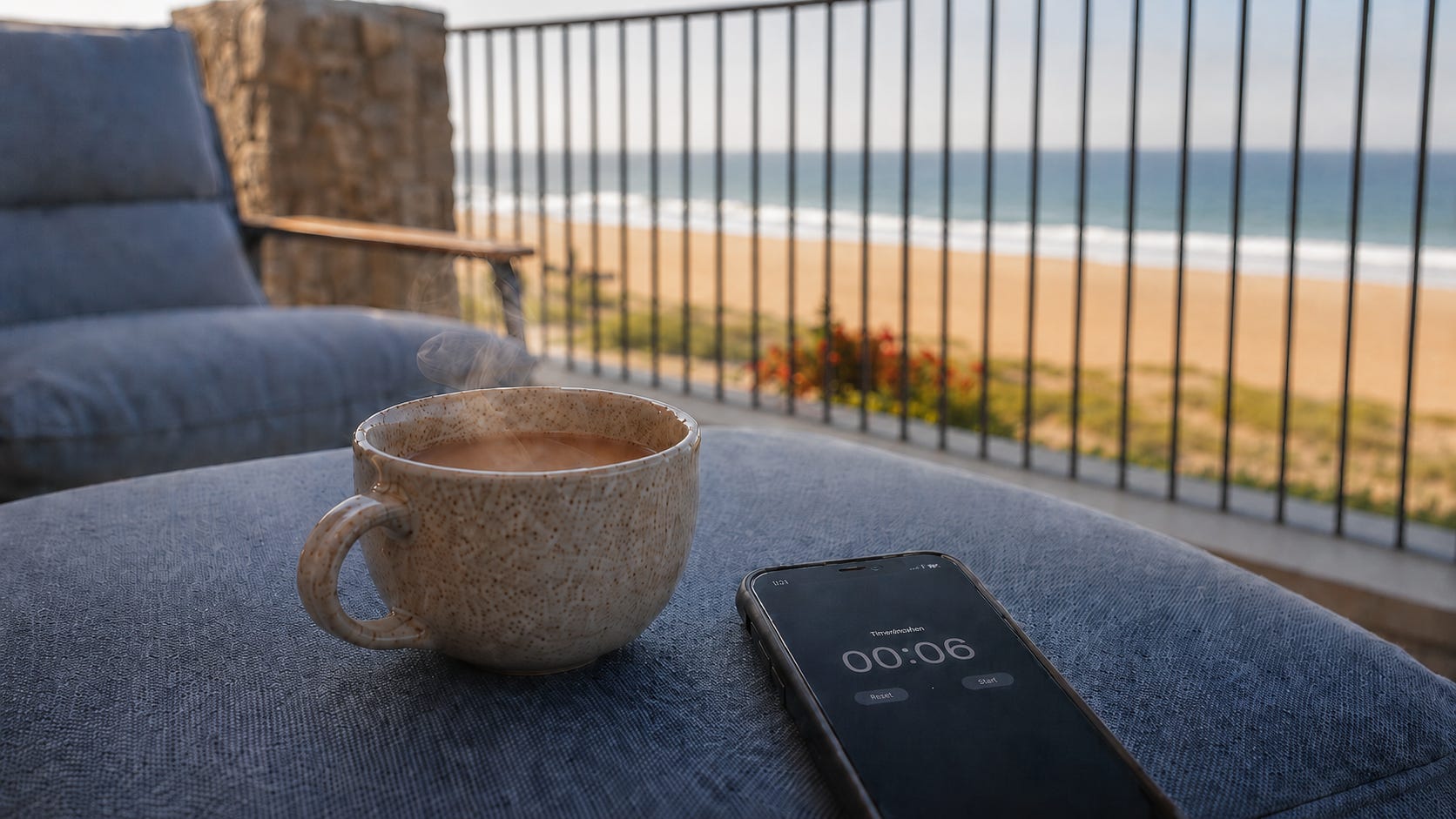
It lasted about six seconds.
I was outside with my morning chai, home from the second of back-to-back trips. I’d already played Wordle and the rest of my ritualistic brain games. For once, I wasn’t thinking about anything. Then I noticed I wasn’t thinking about anything. That was it. Gone.
Because the second I noticed, I thought, this is one of those small present moments I’m always telling people to have. And right after that, I thought, this would be a good way to start the next newsletter.
So here we are. You’re reading it. I turned six good seconds into an assignment before they were even over.
I’ve been doing this newsletter for nine weeks. In that time I’ve somehow lost the ability to just have a nice time. Everything good that happens now comes with a second thought attached.
“How do I use this?”
A walk turns into something to write about. Dinner turns into an example. A quiet morning turns into, well, this.
Maybe you do this too. You’re somewhere beautiful, and half of your brain is already framing the photo.
For years I thought of this as a young person’s problem. I’d watch people work so hard to look like they were having a great time instead of actually having one. The whole performance was arranged for people who weren’t even there. It made me sad. A little smug, too. That wasn’t me. I don’t take selfies. I don’t care about a feed.
But it is me. I do the same thing with words that they do with pictures. The only difference is I’m slower about it, and I get to call mine writing.
It gets worse for me because I write about this exact thing. I catch myself doing it, then I start watching myself catch myself, and before long I’m just a guy in a chair thinking about thinking, not really anywhere at all. The newsletter about being present has made me the least present I’ve ever been.
And then there’s the hypocrisy. This whole newsletter is about one thing. Pay attention to your real life. Don’t hand it over to whatever’s easiest.
I believe that. Then I spend half the week writing posts designed to pull people out of wherever they are and onto my Substack.
When I write a post to get you to click one of these, I’ve learned to stop it right before the satisfying part, so the only way to get the rest is to come read it. That’s on purpose. People teach this. I’m getting better at it. So right now there’s probably somebody standing in their kitchen, in the middle of their actual life, who I interrupted on purpose to tell them to stop letting things interrupt their life.
What’s wrong with me?
Here’s something I’m not sure I should admit. Some of this newsletter gets written with the help of AI. I sit down to write about protecting your own voice and judgment, and there’s a tool right there offering me cleaner sentences. I take them. It helps.
That’s the whole problem.
It helps so much that I can’t always tell where I stop and it starts. Especially when I’m tired, or busy, or both. That’s the exact line this newsletter keeps telling you not to cross. I cross it a little every week.
The truth is, the pressure is not coming from anybody but me. Nobody’s sitting around waiting on my thoughts about attention. I’ve got a subscriber number written down that I want to hit by the end of summer, and I treat it like I owe somebody something. I don’t. I made all of it up. The deadline. The whole weight of it. I’ve spent years telling people not to run their lives on “should,” and I built myself a “should” with a publish button on it.
I told Liz I was stressed about getting this issue out while we were visiting family. She didn’t try to fix it. She just said, “You could just not.” Like that was an option. Like I hadn’t signed a contract with nobody that says I have to have opinions on a schedule.
She’s right. That’s the part that bugs me. I could just not.
I know how this is supposed to end. I close the laptop, walk outside, and finally take my own advice. Lesson learned.
I can’t give you that. Think about it for a second.
To tell you I went and lived my life, I’d have to come back inside and write it down, which means some part of me didn’t really leave, which means you’re sitting here reading about my walk instead of me actually taking it.
So I’m not taking the walk right now. I’m going to post this first. Then maybe the walk.
And you should probably put your phone down too. I know. Me too.
Right after I hit publish.
Thank you for an excellent piece on presence. It is a tough topic to experience, let alone write about. And so I appreciate your observation that writing about presence while concurrently not being present to do so - could be seen as hypocritical as your behaviors and thinking about presence may contradict your stated goal of being more present.
But perhaps a more helpful description could be to consider that the paradigm of presence/non presence points to the nature of presence as a paradox.
I think that the realm of being truly present is paradoxical because the moment you notice being in the moment, you’re out of that moment.
And if that’s the case then how can anyone ever learn about or share about presence without (at least sometimes) being non-present?
Regardless of describing these experiences as hypocrisy or as paradox, the key is you are on a path of “beingness” which can be a wonderful thing for you to experience and for your readers to hear about.
And although I can relate to your judgement that “6 seconds” of presence may not feel long enough, all we can ever hope for are moments like those. And then more. And as they add up, who knows what that’ll be like? I look forward to reading what it’s like for you!