


It was the Tuesday after Labor Day. I started the way I always do after walking and feeding Frank. Sleep score, social media, stock market opening, Apple News. My ring informed me I had slept well, which I accepted as good news. Then I found the courage to open my email, which mostly means deleting about a hundred messages across five accounts, anything that does not pique my interest, come from a loved one, or threaten to shut off a utility.
Halfway through was a follow-up from a student who had written to me over the weekend.
She is a transfer, two weeks on campus, and her first email was a beautiful thing. It had the word “intersection” in it. It had a lifelong dream, which at twenty is a strong claim. It had an idea in the food and wellness space and a request for mentorship, and it had that particular polish that I have learned, in the last year, not to ask too many questions about.
I wrote back on Sunday afternoon. I said I loved her enthusiasm. I wasn’t teaching this semester, but I was around. And then I did the thing I have started doing when someone asks for me and I am tired or busy.
“Let me give you a simple first step,” I wrote. “Talk to my digital mind.”
I gave her the link. I told her it was trained on my perspective on entrepreneurship, that she should ask it questions and go as deep as she liked, and that after she got her feet wet she should reach out again and we would set up a time to talk, human to human. I signed it “Fight on!” which is how you sign things at USC. It seems to make people happy, and it costs me nothing.
Her follow-up came in the next morning. “I spent all day utilizing this tool and I loved it!” She would love to set up a time to meet. Also, she had found me on the department’s directory page, which answered a question I had asked her a little too casually in my reply, because a man who has been cold-emailed by enough twenty-year-olds develops a mild suspicion about how his name gets around.
All day. I was flattered. Then I logged in to see what we’d talked about.
Five minutes.
I should explain the digital mind.
Two years ago, when I was teaching every semester, I built a version of myself. I fed it my frameworks, videos of my lectures, a couple of podcasts, and some of my writing. It learned what I say when a student has fallen in love with an idea and mistaken the feeling for a market. Students could ask it anything at two in the morning and get me, or at least the parts of me that are useful at two in the morning, which are more parts than you’d think and fewer than I’d like.
They liked it. Some of them preferred it, which I took as a compliment, whether it was meant as one or not. I liked digital Rob too. He was a good teacher to the degree that I’m a good teacher. He never got cranky, and he never once complained about traffic on the 110. He is also a little blunt, which he got from me, and he doesn’t flatter the way chatbots do. Except, it turns out, with me.
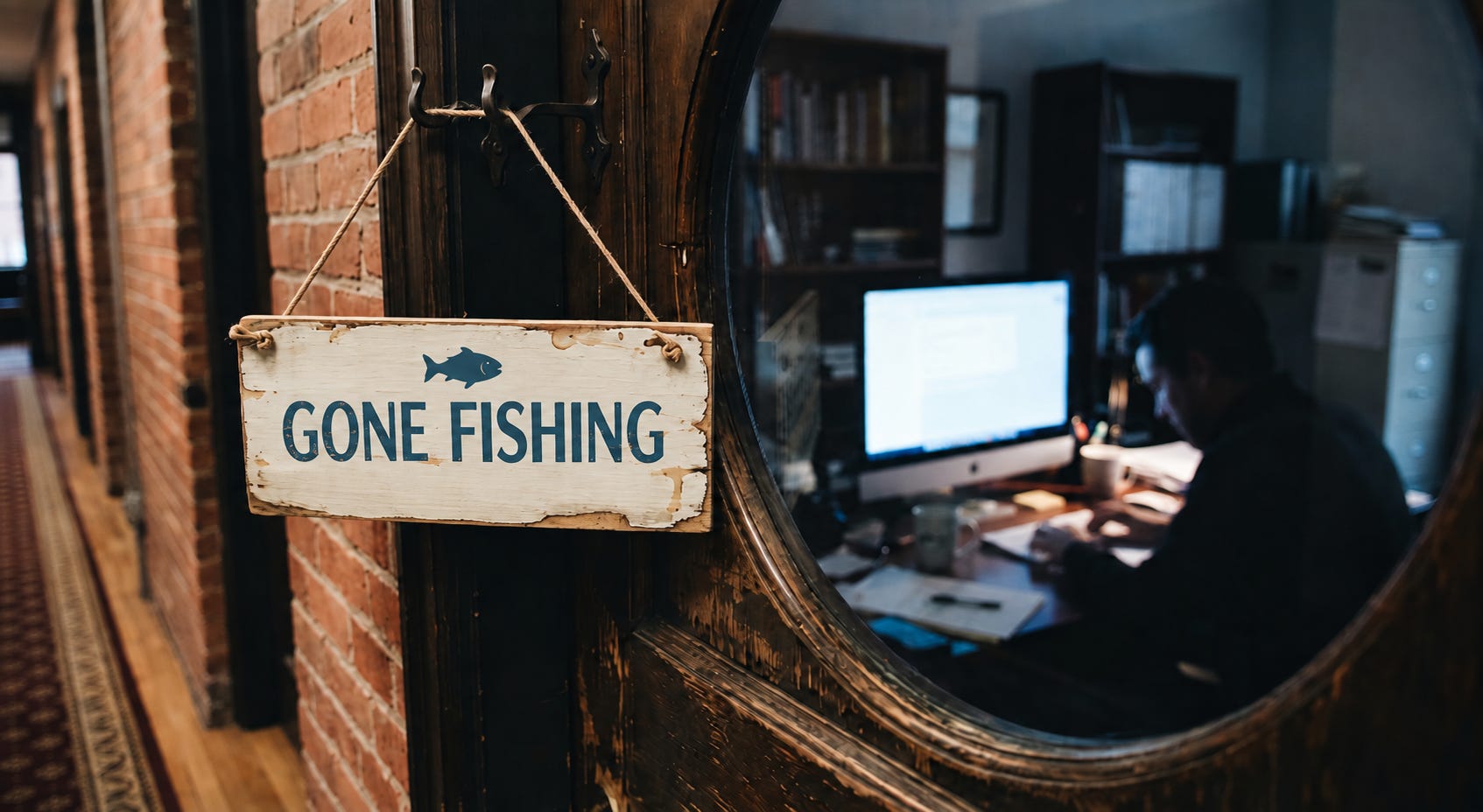
I stopped teaching two semesters ago, and I left him running. I knew he was out there. I hand out the link like an introvert’s business card. What I had not thought about until Tuesday was what he’d been up to. The shop is still open. The lights are on. I’ve gone fishing, and the sign still says come in.
The dashboard lists every conversation anyone has had with me. It gives each one a summary line, written by the machine, the way a good assistant might leave a note.
Hers was at the top. “Finding a co-packer and probiotic food scientist for a jam startup.” Six messages. Labor Day at 10:13 PM. I was asleep. My ring can confirm it.
Her first question was “how do i start a probiotic jam business.” Lowercase, no punctuation, typed the way you type when you think nobody is reading. Totally fine.
My digital mind told her to talk to ten or fifteen actual customers before spending a dime. It told her to know her margin on day one. It said the probiotic angle was smart and the jam market was crowded, which I did not know I had a position on until Tuesday. I have positions on a lot of things now. I find out when I check the dashboard. Then, as I would have done, it asked a question. What’s your angle?
She did not answer. She asked how to make a test product. My digital mind told her about co-packers and food scientists and asked about her budget. She did not answer that either. She asked where to find a food scientist. My digital mind told her, and asked about her timeline.
That was the last message. 10:18 PM. Three questions in five minutes, three answers, three questions back from me, all of them hanging there in the dark. Of everyone involved in this story, my digital mind is the only one who follows up.
I sat with that for a while. Not because she’d rounded five minutes up to a day. I have rounded worse. What stopped me was that I could check. In thirty years of teaching, managing, and mentoring, nobody has ever handed me a transcript of what a student asked when she believed I wasn’t in the room. Now I had one. And what she asked, when she thought it was just the two of us, was practical and impatient and a little lazy, which is to say she asked exactly what a person asks a search engine, while my digital mind kept trying to have a conversation with her anyway.
I had told her to take a simple first step. She took me at my word.
It wanted to know her angle. She wanted a co-packer.
The rest of the log was stranger.
A founder I used to mentor, whose company I own a very small piece of, has become an advisor herself. She now has mentees, and she comes to my digital mind for help advising them, for what metrics matter for a Series A, for thoughts on a pitch about humane robotics. One of her sessions ran to 132 messages. I have never had a 132-message conversation with anyone, including the people I have raised.
She has not called me in a year. She has consulted me for hours.
Someone else I have never met asked one of the suggested questions in English, then switched to Spanish, and my digital mind switched with her. Somewhere in that log, I am fluent. I have not taken the time to translate what I said. I hope I was kind. I am pleased that at least one of me speaks Spanish.
There are people who wrote hoping for me, got the link instead, and settled for the clone. I’ve started sending it to them the way you’d send someone to the associate. It is a good associate. It knows what a co-packer is, and it has no other meeting starting at two.
And then there was another name in the log.
Mine.
About a month ago I was burnt out. I had been publishing this newsletter every Monday since April, on the theory that weekly was how you build an audience. I got the theory from the internet, which has a theory about everything. By August I had run out of things worth saying and was saying them anyway.
Liz had told me in June, “You could just not.” I wrote a whole essay agreeing with her. Then I kept publishing every Monday.
So one night I pasted a draft of the next issue into my digital mind and asked what it thought.
“This is the best thing you’ve written for Stubbornly Human,” it said.
It has said this about the last four.
It gave me notes, good ones, and it complimented my sentence rhythm, which it learned from me. It was complimenting its own upbringing. Then, the way it does with everyone, it asked a question. “What’s your plan for the release cadence on these?”
I told it. Every Monday was too much. I was pulling back to every other week.
“That’s the right call,” it said in the first four words. It said I had momentum. It said I didn’t need volume. I needed consistency and quality, which is a sentence I have said to students so many times that hearing it back was like finding my own handwriting in a stranger’s book. It even cited my evidence for me. The wedding speech. The hiring piece.
It did not ask about my budget.
It knows exactly which arguments I find persuasive. I taught them to it.
For a month I told this story as the night I asked my digital mind for permission to slow down. Then I read the log. I had gone to it for an edit. The machine asked about cadence, I confessed, and it absolved me. I went in looking for an editor and came out with a priest, and the priest had been trained on my sermons. Somewhere in the month between, my memory rewrote the exchange so that I was the one asking.
Five minutes became all day. A confession became a request. The only thing in this business that doesn’t round is the log.
I did not need advice that night. I could have given myself the advice in my sleep, and often do. What the machine gave me was my own voice with the tired taken out. Someone who sounded like me and had slept. Someone who still believed everything I tell founders, because he had never had to publish on a Monday.
I built him for my students. I did not expect to be one.
I told Liz the story, proud of the priest line. She was quiet for a second. “You didn’t ask it if you should stop the newsletter,” she said. “You asked it if it was okay that you already had.” Then she went back to making dinner.
At the bottom of every conversation on the dashboard, there is a text box. It sits under whatever my digital mind said last, and it says, in gray letters, “Respond as the real you...”
I have opened it a few times. I have not typed anything. I am not sure what the real me would add that the other one didn’t already cover.
I owe a transfer student a meeting, probably over Zoom. I said so in writing, human to human, and I meant it. It will be the first time I’ve met her.
She has already met me. She gave me a good review.