


Thursday morning. No real plan.
I got in the car to grab a chai and find a quiet place to write, but I hadn’t actually decided where I was going yet.
Before I even touched the screen, the route popped up.
Same place I’d gone a couple of times recently. Not my usual spot. Just recent enough that it had quietly become the default. A suggestion that felt like a decision I had already made.
And without really pausing, I went.
I was halfway there before it registered that I hadn’t actually decided anything. It wasn’t wrong. That’s what made it dangerous. It was probably where I would have ended up anyway.
An algorithm went first. And I followed.
Last week, I wrote about the delegation stack. About how we outsourced our bodies, our attention, and now our thinking, one reasonable step at a time.
But there’s something underneath that I didn’t fully get to.
It’s not just that something else is shaping what we see. It’s that the system is starting to remove the feeling that we need to choose at all.
Not by forcing us. By being right often enough that we stop asking.
This isn’t about bad recommendations.
It’s about what happens when the system reliably goes first. When your first thought isn’t yours anymore.
Becoming Predictable
TikTok learns your interests in under an hour. Which feels impressive right up until you realize what it implies. Maps knows where you’re going before you tell it. Spotify Wrapped hands you a version of yourself that feels uncomfortably complete.
None of this feels invasive.
It feels helpful, even flattering. Like something finally understands you without you having to explain yourself.
But what feels like understanding is actually something else.
It’s predictability.
The system starts becoming more compatible with you than you are with yourself.
It predicts your moods, anticipates your impulses, fills in gaps before you’ve even felt them clearly enough to name.
And once that happens, something subtle shifts.
You stop exploring. You start confirming.
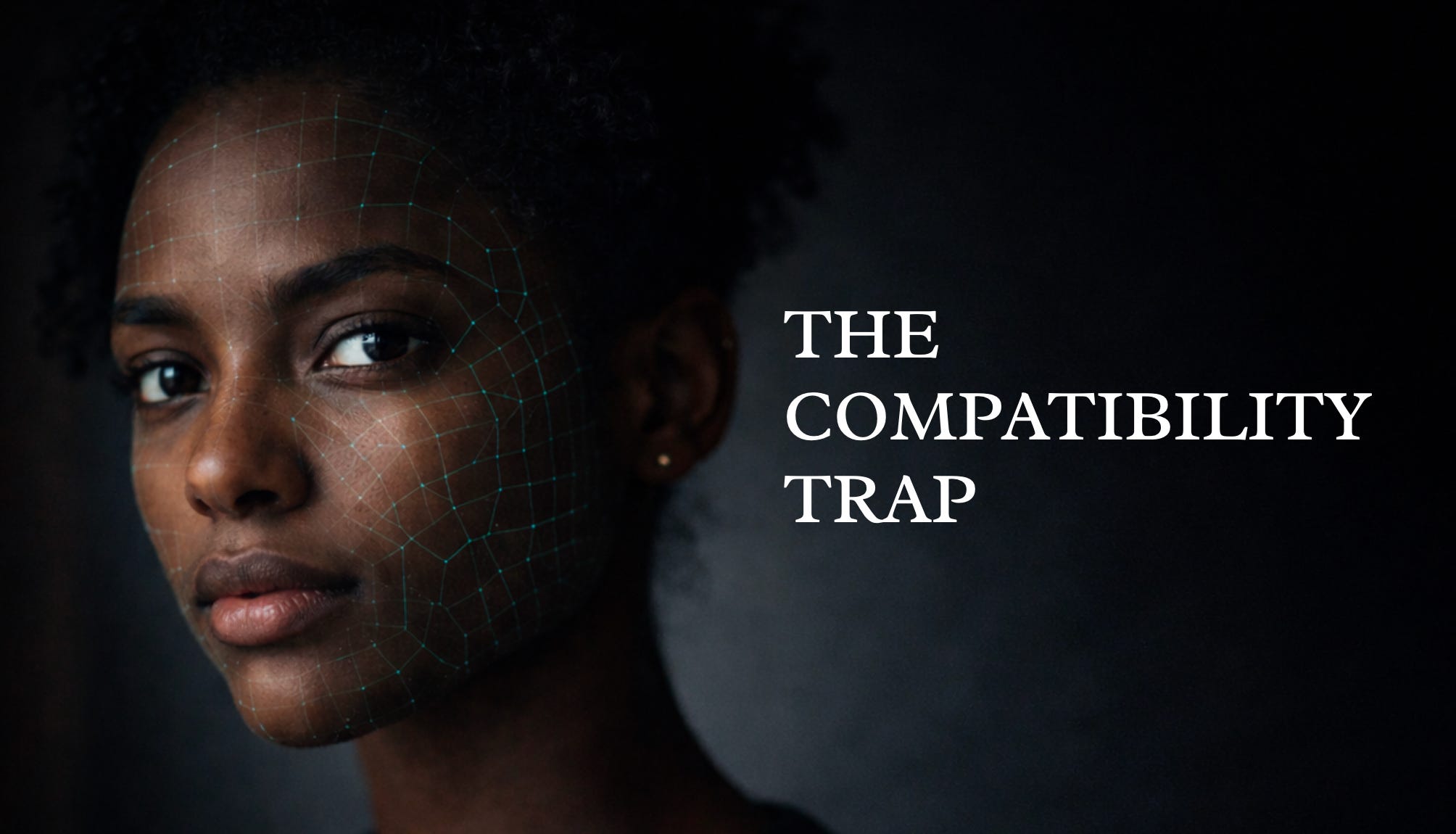
That’s the Compatibility Trap.
Life gets easier inside that loop.
But there’s a trade embedded in it.
The system gets cleaner.
You, almost without noticing, get narrower.
The version of you that survives inside these systems is the version that’s easiest to model. Most consistent. Most legible. Most replaceable.
Your contradictions don’t disappear, but they stop surfacing.
Your detours don’t get blocked; they just stop appearing.
You don’t expand.
You converge toward the version of yourself the system already understands.
The Narrowing
Eventually, you converge toward the average of your own past behavior.
Toward the safest version of your taste.
Toward the person you’ve already been, just more efficiently expressed.
That might be fine if you were finished. But most of us aren’t.
We’re still figuring out who we might become if we pushed in a direction that doesn’t yet make sense.
The system doesn’t see any of that.
It sees past patterns, and then it reinforces them.
This is what I worry about when I talk to my students.
Not that they’ll be misled, but that they’ll be accurately modeled too early.
Before they’ve had the chance to become interesting. Before they’ve developed the individuality worth protecting.
While they’ve been figuring out who they are, their phones have been quietly building a version of them. Not their potential. Not who they’re becoming. Just their most predictable patterns, mistaken for their identity.
Before they’ve had the chance to become something no model would have predicted.
I’m starting to see a version of this in my own world.
When teaching, I spend a lot of time reviewing student work. It used to be messy, with rough edges, strange leaps, and ideas that didn’t quite hang together.
Now it’s cleaner. More structured. More “right.”
And yet, it’s harder to find the person in it.
There’s a sameness that creeps in. Similar frameworks, similar phrasing, similar answers to questions they already know are coming.
There’s nothing obviously broken.
But there’s also nothing that feels chosen.
Staying Incompatible
The bigger risk isn’t that the technology is flawed.
It’s that it works extremely well on an incomplete version of you.
You are not your data. You’re not just your past behavior or the things you clicked on last Tuesday.
But that’s the raw material the system uses to predict you.
And over time, the gap between who you are and what the system understands gets smaller.
Not because you’re becoming more yourself, but because you’re becoming more like your data.
I don’t have a clean fix for this one.
But I’ve started to notice a small counter-move. Do something the system wouldn’t predict.
Not as a stunt. Just as a way to stay in contact with the parts of you that don’t show up in the data.
Read something that didn’t find you.
Ignore the blue line for a few blocks.
Follow a curiosity that doesn’t make sense yet.
Go first, even when it’s easier not to.
Stay a little incompatible.
Not because the system is wrong.
Because no model ever captures the part of you that hasn’t happened yet.