


It was a Friday morning. The plan was simple.
Spencer’s wife had clients to see while they were in town, so for a few hours he would take the kids. Liz and I would get to be grandparents instead of support staff.
He has a one-year-old and a three-year-old, both extremely mobile. He promised to put the phone down and be present, and he meant it.
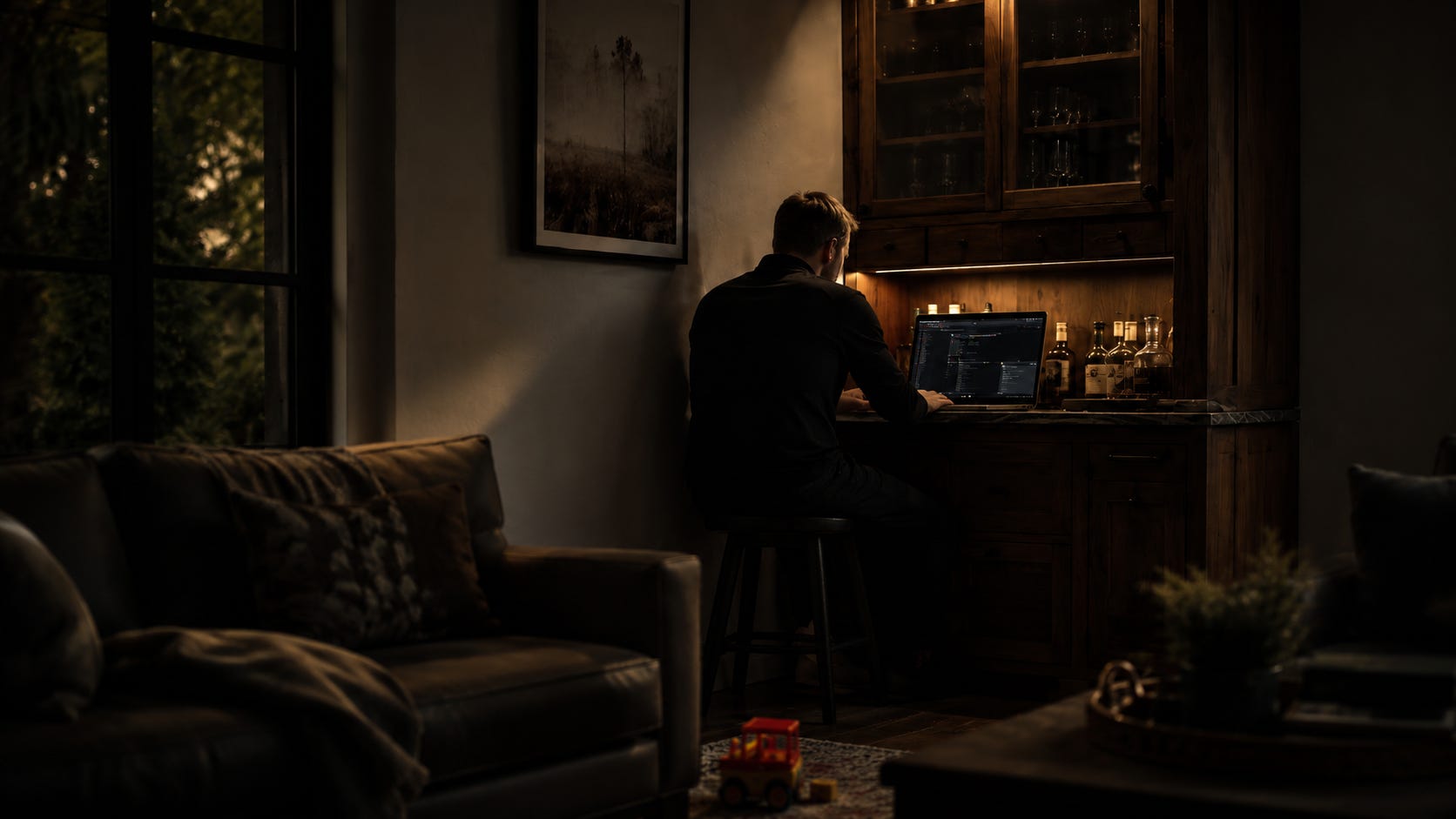
It started out great. We were all in the living room, toys strewn about, the kids doing their thing. Then, quietly, the laptop appeared in the corner.
The first trip over was nothing. He fired up his workspace and set something running, then came back. You kick off a task, let it run, and step back into the room. I didn’t think twice about it.
Then he went again.
And again.
The trips got longer. The agents he had set loose needed direction, and he was the only one who could give it. He would drift over, type for a while, then drift back to us already half gone. Even when he was sitting right with us, I could see the gears turning behind his eyes.
He was somewhere else.
Then the one-year-old went down and hit her head. She cried the way they do, more scared than hurt. I got to her first. He was across the room at the laptop, and he did not turn around. I don’t think he heard her.
Liz saw it too.
The easy read is that my son doesn’t care about his kids, and that is dead wrong. He adores them.
What happened on that floor was quieter and stranger than not caring. He had done a kind of math without realizing it. The kids had backup. Liz and I were right there. The work had only him. So he gave himself to the one thing nobody else in the room could cover.
In that narrow sense, he was right. The work could not be handed off in that moment.
He just had the wrong irreplaceable thing in front of him.
He thought the lost stretch of output was what he could never get back. He had it exactly backward. What you can never get back is your hand on your daughter’s back the second after she falls.
And I need to be fair to him, because the pull is real. Spencer is a founding engineer at an AI startup. A while back, he pushed hard for a platform rebuild that, by any normal accounting, should have taken a much bigger team and far more time than they had. Instead, they leaned into what the agents could do, and so far the bet is paying off. Doing more with less made Spencer one of the people the whole thing now rides on. His name is on it.
So when he gets up off the floor and crosses to the laptop, there is a logic to it. He is protecting a bet he believes in, one the company is now built on.
That is what makes it so hard to say anything to him. You cannot easily tell a person to ease off the very thing that is proving him right.
And I can’t stand over him either, because I caught myself doing a smaller version of it the same weekend. I have started to treat Claude like a second brain, something to feed and keep running in the background. I feel uneasy when it isn’t working on something for me.
I have kicked off a task at a stoplight more than once, telling myself I would pick it up when I got home. Nothing was ever really riding on it, and nobody was waiting. My stakes are nothing like his.
But there I was.
We were braced for the wrong danger. The story was that AI would make us redundant, that the machine would do the work and leave us with nothing.
What is happening to the people who are good at this is almost the reverse.
Rather than replace Spencer, the agents multiply him. He is more valuable now than he has ever been, and that is exactly the trap.
When one person and a swarm of agents can do the work of a whole team, the work no longer has an end. There used to be natural limits. You were one person with a set number of hours, and the work waited on others to finish their parts. You stopped because the system stopped with you.
Those limits are disappearing.
The team never sleeps. There is always another task you could start, and now you actually can, from the couch or from your phone.
The only thing left to tell you to stop is you, and you are being paid, in money and in the quiet thrill of the thing working, to never stop.
We at least learned to feel guilty about doomscrolling. This is productive distraction. It carries no guilt at all, because it looks exactly like what we are supposed to be doing. The most driven people I know will be the first to disappear into it, and they will be praised the entire time.
I never got the full conversation with Spencer that I wanted. There was never a clean moment for it. So a little later, I sent him a text.
When you need to work, work.
When you’re not working, be present and fully there.
Be more binary.
You can do it.
Be more binary became the whole message.
When you’re working, go all the way in. Leave the room if you have to.
And when you’re not working, be here. No phone. No laptop humming in the corner. You’ll be better for the people in front of you, and the work will be sharper when you come back to it anyway.
We both have work to do here. It’s harder for him. He’s in the thick of his career, at a company built on exactly this, with two small kids and a bet to win. I’m further down the road in seeing the thing for what it is, and a lot less is riding on whether I get it right.
Neither of us has it figured out.
Maybe we get each other there.
I don’t want to give the productivity up. It is genuinely something to behold. I just don’t want the laptop in the corner deciding what matters.
Be more binary. Be human and get the work done. Both of them, on purpose.
That’s the thing I’m still trying to learn, one stoplight at a time.