


My financial advisor told me the other day that enterprise software is dead.
He did not say it as a fact. He floated it and then watched me, the way you test a stair before you trust it with your weight. I am the software guy in his book of clients, so my reaction was part of what he came to collect. This is the prevailing investment thesis right now. AI writes code, so why keep paying Salesforce a fortune for what a good prompt can conjure by Thursday? The giants are dead men walking. He wanted to see whether the software guy would nod along.
I told him it was an oversimplification and an overreaction. That there is truth in it, and that the truth is more complicated than companies suddenly solving their own problems with a chatbot. Plenty of them will try. And then they will find out that being your own third-party developer is not nearly as fun as it sounds.
He nodded the way a man nods when he has money on the other side of your opinion.
And I felt the thing I often feel these days. A small tightening. The particular discomfort of not believing something that the whole room, and in this case the whole market, has already agreed is true.
Here is the part I did not say out loud.
I have heard this exact confidence before. Not something like it. This. And I remember how it ended.
It ended with a spreadsheet.
Years ago, I worked at a company called Carbon. We printed objects in three dimensions, and we did it beautifully, and early on, we walked around convinced we were going to completely remake how the physical world got built.
Not a slice of it.
All of it.
We talked about injection molding the way people now talk about Salesforce, as an incumbent whose obituary had already been drafted and was merely waiting for the market to catch up.
Then somebody opened Excel.
I want to be honest about which chair I was sitting in. I was not the sage at the back of the room warning that the old ways would endure. I had the same Kool-Aid mustache as everybody else. The spreadsheet did not confirm what I secretly knew.
It corrected me.
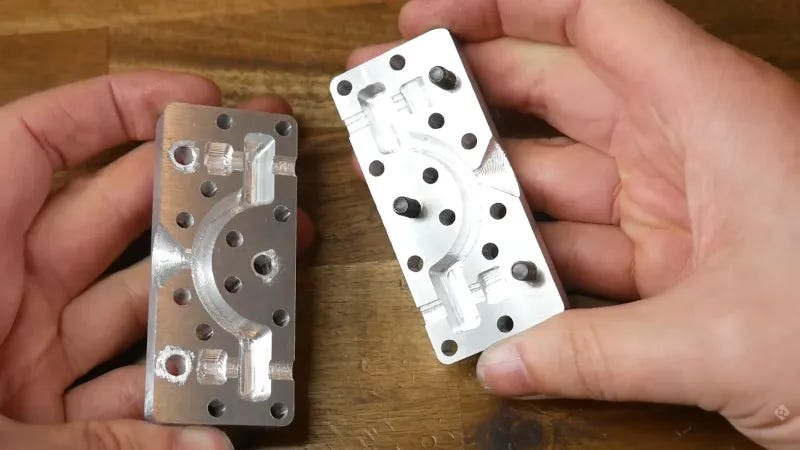
A mold costs a fortune to make and almost nothing to use. Pay for it once, and every part after that comes out for pennies. So if you need a million identical cups, injection molding is not merely better. It is not even a contest. Printing those cups one at a time would be the act of a lunatic.
Our machines were the opposite animal. No mold, no setup. But every part cost real money and real time, and that did not magically disappear just because you wanted more of them.
We were miraculous at precisely one thing.
Making what no mold could make.
That was the lesson sitting there in the cells. Making something formerly impossible only matters when it beats the possible. Handily. A cup you can mold for a penny does not become holier because you printed it instead. That is a magic trick, and an expensive one.
The miracle only counts at the edge, where the alternative was nothing at all.
Think about those clear plastic aligners that straighten teeth.
You know the ones. They chart a route from the mouth you have to the smile you want, a private path no two people share, because no two mouths are the same problem.
There is no standard shape to build a mold around. Every set differs by necessity. That is the far edge of the curve, the made-for-one object no mold could ever produce.
For years, though, even that market did not quite work the way the futurists would have drawn it on a whiteboard.
The printer did not make the aligner. The printer made a form. The aligner was then made on top of that form using an older method. And when the aligner was finished, the printed part went into the trash.
Scaffolding.
Waste material.
The revolutionary machine spent its first years running errands for the method it was supposedly there to replace.
Then the category turned.
The printer stopped imitating the mold and became the product. The finished thing itself could be printed directly, shaped to one person’s specific problem, without the discarded step in between.
That was the real moment, and it did not come when the printer arrived. It came when the printer stopped helping the old method move faster and started making the thing that never had a mold.
Sometimes the revolution takes time.
So I think I know what the spreadsheet would say about my advisor’s thesis.
The defensible answer, the one I gave him, is that enterprise software is not dead, and the reason has very little to do with code. Nobody buying it was ever really buying code. They were buying everything wrapped around it. The testing someone else ran, the liability someone else carried the night the whole thing broke at two in the morning. A company signing that check is buying someone to hold accountable, and the software is what the accountability attaches to. AI has made writing code nearly free. What it has not made free, and cannot make free, is the cost of trust.
That is the mold. Ruinously expensive to stand up, unbeatable once it exists, and resented by everyone who depends on it. A prompt can generate the code in an afternoon. The accountability behind it takes years to earn, and no prompt has ever produced a scrap of it.
But that is the boring half of what I think. It is the answer that wins the argument over dinner and misses the actual story. The interesting question was never whether the giants survive. They will. The interesting question is what gets built at the far edge, while everyone stands around watching the giants.
The far edge is where I have been before. In resin, it was where the alternative was nothing at all.
Something can now be built for one person, from that person’s own life data, toward a goal only that person has. A route from where they are to where they are trying to get, computed just for them, because no company on earth would have bothered to build it before.
And the one need not be a person. It can be a single team or a single company with a problem so particular that no vendor could ever justify solving it. The whole long tail of things that were never worth building, every size of them beneath a market, is suddenly worth building. That is the landscape shifting, the way my advisor says it will. Just not by the giants falling. It shifts because the ground beneath them fills in with ten thousand things no price list ever carried.
A market of one is not a market.
That used to be the end of the sentence.
Now it may be the beginning.
I made one of these for my father. I have told that story already, so I will spare you the retelling. What matters here is what it was underneath. It was an aligner. It knew where he was and where he wanted to be, and it mapped a path between the two, fitted to a problem that was his alone. A small thing built for one old man, and for the daughter and son who wanted proof he was still moving forward.
It had no mold.
It never needed one.
That is the direct-print moment, realized in software rather than resin.
And this is the thing nearly everyone is getting wrong.
Most of what is being sold to you right now as the AI revolution is mold-printing.
It is the machine running errands for the old method. Generating boilerplate faster. Autocompleting the same software we already had, built the same way, for the same buyers.
The meeting assistant that writes the recap a human used to write, then drops it into the same CRM field. The coding copilot that helps a developer ship the same dashboard, behind the same login screen, for the same procurement process. The customer-service bot trained to impersonate the phone tree it was supposed to free us from.
All of it is useful. None of it is the revolution.
A quicker path to the same old form is still the same old form. A great deal of what we are marveling at right now is scaffolding headed for the trash, exactly like those first printed molds.
People point at that and call it the future.
Making the old thing faster was never going to be the revolution. The revolution is quieter. It is already underway at the edge, where the machine is beginning to make the thing nobody has ever built before, because it was only ever worth building for one.
Which is roughly where I lose interest in the argument I have been having.
Because the fight everyone wants is the cage match. Which giant falls, which platform wins, whose stock gets vaporized when the bubble finally does what bubbles do.
Fortunes are going to evaporate. People will lose their shirts betting that the impossible is automatically better than the possible. A little of what gets built in the frenzy will outlast it and quietly become the ground on which the next thing stands. Most of it is smoke, and the survivors will not bother to tell you which was which.
But all of that is playing out at the altitude of markets, aimed over the heads of actual people.
The thing I keep looking at is lower than that and harder to see.
And I think it matters more.
Something can now be made for one person.
Not run off a line of a million and sold down to you, but made from the start for exactly one. From the data of a single life, toward the shape of a single hope.
A particular mouth and the specific smile it is trying to become.
A particular father and the strength he is trying to recover.
These things rarely show up on anyone’s market map. They are too small to register. They always were. Being too small was the whole reason they used to be impossible.
The people arguing about enterprise are staring at the cathedral, waiting to see which spire cracks first. I keep drifting to the far edge, where a machine no one thought to aim in that direction has quietly started making things meant for one person.
I could be wrong about all of it. Last time, I was certain we would remake the world, and it took a spreadsheet to talk me down. I would be a fool to trust my own certainty more now than it has earned.
So I will plant the flag here, with a date on it. My advisor is betting the market. I am betting on the spreadsheet I watched humble a room full of true believers back at Carbon. In a couple of years, one of us will collect.
I will be down at the small end of the curve, watching the thing that never had a mold become possible for one person, and then another.
Another great read, Rob. I remember well when you were at Carbon. Your analogy paints a vivid picture.