


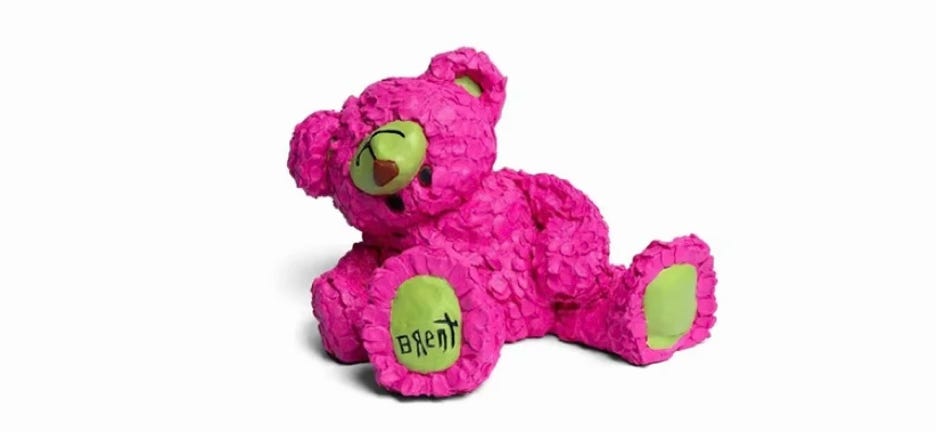
In September, Los Angeles artist Brent Estabrook put twenty-five sculptures called “Smiles” on sale for $5,000 each. They are hot-pink bears with mint-green faces, every one of them upside down. Every bear is painted by hand. At the bottom of the announcement, where a company would typically place its legal disclaimer, Brent included his. “No AI is used in any part of his creative process.”
I believe him. I also spent the summer telling him which part of the bear was worth the least. Then I asked if I could paint it.
A few weeks ago, in “Family Portrait,” I admitted out loud to calling a painting “pure” and meant it. Brent’s disclaimer says the same thing in smaller type.
The line
Brent is the one who taught me the studio model. Jeff Koons supplies the idea. Assistants do the physical work. The market looked at this arrangement, decided it was still a Koons, and has not looked back. The assistants have looked back, I assume, but nobody asks them.
He is deciding how much of it to adopt himself, and by his own description he is torn. He has started to allow that AI might help with the business. The art is off-limits.
The funny part is that the art is already a group project. A Smiles is made in three layers. Brent sculpted the bear years ago. His studio partner JP makes the molds and pours the casts. Younger artists are learning to paint them to match the artist’s proof. Two of the three layers already belong to other hands, and the third is painted to match his. The thing Brent won’t let near the art is already in the building, in the form of people he likes, and he is at peace with that.
I spent six years at Apple, where we shipped objects that said “Designed by Apple in California” on the back and were assembled by other hands in other countries, by the million. Nobody ever asked whose MacBook it was. Anyone whose first draft came out of a model this year is standing over the same cast, asking which layer is theirs.
The feedback
Somewhere between the catering and the guest list for that painting’s unveiling, Brent and I got to talking about where he adds value.
I know his work from the inside. This spring he painted Liz and me a five-foot pile of our family’s most important stuffed animals, including Ellie, the elephant I have had for fifty-five years. On that painting, the texture is the whole miracle. Every animal has its own fur, its own nap, its own history in the pile. On the bear, the texture is sculpted into the cast. It is already there when the resin comes out of the mold.
The paint, I told him, mostly just makes it pink. Hand that layer to the studio, and he gets his hours back for the parts only he can do, new sculptures and the 1-of-1s, where the painting is the whole point.
I may have implied I could do it myself. Sometimes I lose touch with decorum.
He said he appreciated it, which is what people say. Then he went quiet, asked me to explain it twice more, and said he wished more people were willing to be that direct with him, which is not what people say.
He has since made the case back to me. The color, the surface, and the small decisions with a brush are what turn a cast into a finished Estabrook. He paints the artist proofs himself. The first of those went to Chef Nobu Matsuhisa, which tells you something about the artist proofs and something about where Brent eats. The studio paints the editions to match. Brent says he is still deciding. The price list suggests otherwise.
Our family could tell Brent which toy in that pile could change color because we grew up with those animals. Nobody has grown up with a Smiles yet, so the rules have to go on the price list.
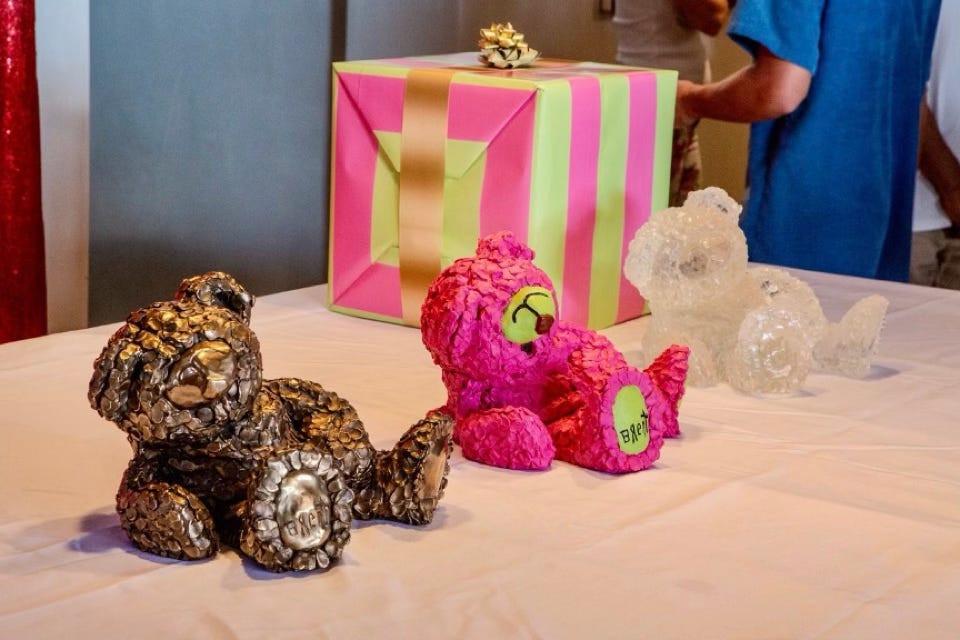
I also told him to put the whole process on the table at the unveiling. He did. The original bronze, the raw resin cast and the painted artist’s proof sat side by side. So the same friend who told him the paint didn’t matter told him to put the paint on display. I stand by both. Koons never lets you see the middle object.
My line
I have been through this same sorting myself, and I did it worse.
In “The Distillery,” I wrote about the treaty I signed with my family after I sent two friends eleven pages about a vacation. I kept one rule from it. No first draft leaves the house. A first draft is not an invitation, and mailing one cost me a friendship for about a week.
I dropped the other rule, the one where I hid the machine behind a borrowed website. That one protected nothing but the receipts. Then I went to Italy and texted my friends a plan signed “From a friend.”
Brent puts his disclaimer at the bottom. Mine went at the top. His is true.
I ended “The Distillery” by taking back the em-dash. It did not stay taken. I now scrub em-dashes, colons, and semicolons from my writing, because a well-placed semicolon now reads as a confession. I am deliberately removing punctuation that comes naturally to me so the writing will look more like mine. Which makes me considerably less qualified to lecture Brent about the pink paint.
Brent’s problem was never the painting. He is very good at it. The problem is that he is also the only one in his studio who can invent the next bear, make the next painting, or decide what an Estabrook should be. Every hour he spends on something another painter can do to his standard is an hour he doesn’t spend on the things only he can do.
That is why I told him to hand over the brush.
Then I go home and wonder whether it’s cheating to let Grammarly check my commas. I know where commas go. Grammarly is just faster.
Asking AI to poke holes in an argument bothers me more. I could spend another afternoon finding the holes myself. I could ask a friend, which somehow feels purer, even though the friend would be doing exactly what I asked the machine to do. I asked a machine to poke holes in this essay. It found plenty. I took some of its advice and argued with the rest.
Brent does not become more Brent by spending another afternoon making a bear pink. I do not become more myself by missing a comma. At least I don’t think so.
My first draft still feels different to me. I need to decide what I am trying to say before I ask anyone, human or otherwise, whether I have said it. Brent still paints the artist proofs himself. Maybe there are parts of the work where purity really is the point.
And then there are the pink bears.
The ask
When Brent resurfaced from Burning Man, which is where Los Angeles artists go in late summer to be unreachable on purpose, I asked if I could paint one of the twenty-five. My decorum had not improved over the summer.
I should disclose my qualifications. I am semi-retired. The “semi” part is mostly silent these days. For the past six months I have been building a dollhouse for my granddaughter, painted white and then, room by room, a series of girly colors, with the care of a perfectionist and the enthusiasm of a man who has discovered that dollhouses have a great many rooms. It is not art. It is, however, a documented history of making small things pink.
Brent said yes. I think his exact words were, “Absolutely. I’d love that!” We’re not sure which number it will be, but I’m calling it number seventeen. I don’t want to be early, and I don’t want to go last.
I do not know whether a day in his studio will feel like making art or like the dollhouse. I do not know whether the collector who pays $5,000 for a bear I painted will have bought an Estabrook or my afternoon. Brent may not know either. That is the only reason I felt entitled to ask.
The signature will not settle it. It is cast into the foot, a copy of a mark Brent made once on the original bronze, reproduced on every bear before anyone picks up a brush. Only the number goes on by hand.
I will report back on which part was mine.
Brent is my friend. He read this before it ran. I have no financial stake in the bears, only an emotional one in number seventeen.
Stubbornly Human is a newsletter of essays about what stays ours as machines get better at being us. A new essay arrives every other Monday. It’s free, and I write it myself. Mostly.